The start to the Premier League was always going to be tough for the Gunners, as indeed it was for many other teams. Manchester United lost at home despite numerous seemingly strong performances in preseason. Everton drew, Tottenham got lucky, and the top two from last year had to fight very hard for their wins.
In that sense, and with the knowledge that the Gunners are missing key players, the result against Palace was a welcome one. As Wenger often says though, we must step back from the result and analyze the game without taking it into consideration.
It wasn’t a great game of football from the Gunners. There’s no denying that. At the same time, no one should turn a blind eye to the mitigating circumstances and the difficulties faced by other teams that are fighting for the same prizes. Our analysis must, therefore, differentiate between the problems that were understandable and excusable, and those that need to be addressed urgently.
I’d have easily accepted the reasons (insufficient preseason, key players missing, new players still adapting, etc) for the below par effort had this been a one-off performance. But look back at last season objectively and you’ll recall quite a few game against mid to low level teams where Arsenal had to grind out a result. Playing ugly and winning can be a good thing, but only when it’s a rare occurrence in an otherwise dominant run. Last season the Gunners had successful periods but they weren’t dominant ones. And that was the reason I wasn’t too excited about the title challenge. You could see it crumbling once the big games came around. The first blip came in December and then it was all over by the end of March.
Teams that have to consistently fight very hard to beat the smaller clubs will not be able to repeat those performances against the big sides who offer a much more potent attacking threat and are, as an extension, more secure at the back. So, while we should acknowledge the issues that affect the team, it’s very important to also realize there are certain deeper problems that offer genuine cause for concern.
1) Too slow in the central third
I was expecting Palace to sit a little deeper with their two lines right on top of each other with a gap of around 5-7 meters. For a while, thus, it surprised me when they seemed to be pressing around the centre line. Closer observation made things clearer.
Palace were really just sitting back, about 10-15 yards inside their own half, while maintaining good spacing from a defensive point of view. The Gunners had the ball around the centre line but instead of moving it around quickly, too many players were looking to make something happen all the time. Their desire and spirit were admirable but their tactical maturity and game intelligence were not.
When pass-and-move works as it’s supposed to, the opponents are constantly chasing the ball and have very little time to catch their breath. But sometimes the players in possession don’t make the simple pass that’s become available due to a teammates movement and instead wait for another opportunity for a better pass further forward. This discourages the teammate who’s showed for the ball while the others up front are waiting because they have very little space in a congested area. The rhythm of the possession game is disrupted and the opponent gets a chance to close the ball down higher up the pitch.
This explains how the Eagles were able to press the ball in the centre. They were not very good at it though and committed many fouls. They committed 19 fouls in this game and 12 of those came in the central third of the pitch.
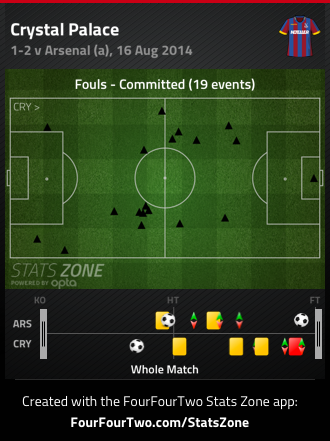
12/19 fouls in the central third
Better teams would have a few successful tackles there instead of the fouls and these would lead to very dangerous counter-attacking opportunities.
To an extent, Arsenal’s problem was understandable. The two players on the right flank were debutants and the midfield combination, with Wilshere and Ramsey in box-to-box roles, isn’t the usual one. Sanogo hasn’t played too many games at the centre of the attack either. It’s hard to find fluidity under such circumstances.
Most of Wenger’s teams played their best football when the players get a run of games together and there is some stability. While it is completely understandable, it’s also not good enough to win the major titles anymore. Injury problems, need for rotations, fixture congestion, and other factors mean that the same line up cannot play bulk of the games. It is, as a result, absolutely imperative that Wenger finds a way to develop the tactical level of his players so they can find the fluidity irrespective of the starting eleven and other circumstances.
They have to rely on their passing and movement to create pockets of space rather than waiting for space to appear in which they can play the killer pass. It can be tedious, but the degree of precision and efficiency they achieve in this process will have a direct bearing on where they finish the season.
2) Defensive thought and set-piece preparation
Palace were resolute in defence and worked very hard. Credit to them for that. However, it’s impossible to say they offered any offensive threat whatsoever. Despite that, the Gunners some contrived to make mistake after mistake in gifting them a goal. This is another major cause for concern.
It started with a poor pass from Chambers. Part of it is excused by his youthful exuberance and inexperience. We can also appreciate that he was trying to do something positive. This though, was another case of a player taking unnecessary risk when many simpler options were available. It is very important that defensive players (Centre Backs, Defensive Midfielders, Full Backs in defensive positions) are constantly aware of the shape of the team at any given moment and work very hard to ensure they don’t lose the ball. And never in a central area because that completely opens the game up for the opponent.
Once Chambers gave the ball away and the counter-attack was on, the second mistake came from Szczesny. He’s been trying to play the sweeper, as was obvious from a couple of preseason games, but he clearly doesn’t know how to pick the right moments. I thought Koscielny was in a good position to deal with the ball and the Pole could have stayed back without any problems.
Having decided to charge forward, Szczesny again betrayed his inability to assess danger as he lumped the ball forward into a very dangerous area where there was no teammate to challenge a grateful opponent. I don’t know whether he was trying to play a pass-cum-clearance, in which case it was poor execution, or if simply didn’t think about what he was doing. The best option for the ‘Keeper in such cases is to put the ball out of play. This gives everyone a chance to get back into position. Obviously, he’d have to adjust his body shape as he arrived at the ball in order to hit it towards the touchline. Time would not have been a problem had he been clear about it from the moment he sensed danger.
The errors by Chambers and Szczesny show a lack of defensive thought that has repeatedly plagued the Arsenal defence over the years in one form or another.
Koscielny made a good block (although the shot was probably going wide) and then a good tackle as the ball went out of play. The danger should have been averted but for Arsenal’s set-piece vulnerability.
There must have been some analysis in the summer that suggested that the Gunners didn’t need a man on any post. Maybe there is merit to it, which will be proven in the long run. This is something we should keep an eye on.
The main problem in defending that corner seemed to be a poor understanding of roles.
For instance, Sanogo was at the near post. Usually strikers are needed there and do a good job of clearing such balls. However, when Chamakh made a run and took up a position just in front of him, the youngster seemed confused. Koscielny then pointed, and presumably said something, after which the lanky forward went a couple of steps ahead to mark one of his predecessors. That little movement probably meant the ball was able to float over his head and drop perfectly for Hangeland.
The goalscorer’s run and Arsenal’s response to that also showed the problems with the requirements of the system as understood by the players. Initially, it was Sanchez marking the giant defender. In fairness, the Chilean was simply marking a zone (probably pre-assigned in training) that the Norwegian was occupying. At first Alexis went with the run of the former Fulham man, as if by instinct. And then, confused, he let him go, glancing back with a worried look to check if his zone had been compromised. All this while, Koscielny was not aware of his counterpart’s movement and it was too late by the time he reacted.
A lot of these things came together for that goal to materialize. Had Arsenal put a man on the back post, or if Sanogo had held his ground, or if Sanchez communicated to Koscielny the moment Hangeland made that run, this goal could have been averted or at least made much harder to score with pressure on the header.
Mertesacker’s return should help things but I think a lot more work is needed on the training ground.
3) Too many take-ons
The Gunners attempted 37 take-ons and lost most of them.
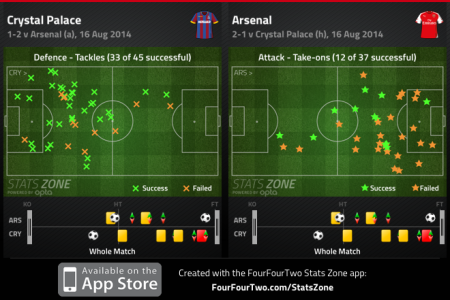
Alexis was successful with 3 of his 10 attempts. Ramsey managed 1 out of 6. Sanogo had a fifty percent success rate from his four attempts and Cazorla did just better with 5 out of 8 (although he lost a couple that broke promising moments down).
This numbers are too high and corroborate the tendency to do too much as discussed earlier. When things are not going your way it’s better to revert to the basics and keep things simple. I’d rather they lost possession trying intricate combinations with quick touches, or when making more runs in behind, or via intercepted through-balls rather than lost take-on attempts.
That said, we should see some improvement on this front once the players get their sharpness back. Nevertheless, it would be better if they’re aware of their sharpness levels and make appropriate choices based on that.
The Positives
Apart from the result of course, there were a few other details that were appreciable.
The equalizer was well worked and Koscielny’s header was clever because it was a tough angle.
I also liked the way the team kept going till the end. Wenger made good substitutions. Their concentration levels right at the end were excellent and I also enjoyed the way Koscielny and Giroud directed their headers purposefully.
Debuchy took up really aggressive positions and that can lead to threatening moments if used well.
Some other positives are covered in individual analysis.
This section is much smaller than the problem areas discussed above but don’t take that to be a ratio of the bad and the good from this game. Areas of concern need some elaboration and thus that write up is much longer. We expect Arsenal to win such games, which in turn implies the team is really good. There is no need to explain the strong points we see every day.
Individual Performances
Szczesny: Was a spectator for long periods. Handling was good when the ball did come at him. Didn’t have any saves to make. The lack of defensive thought discussed above is a concern. Could he have done more to organize the defence for the first corner?
Debuchy: Saw a lot of the ball and used it well. I loved his shot on the swivel in injury time and the positions he took up in the box when the ball was on the other flank. Wasn’t really tested in defence. I’m not sure if his aggressive positioning was just natural or part of the game plan. Will have to keep an eye on this in other games and see how it changes based on the opposition. It’s important that the full back doesn’t lose sight of his defensive duties or get in the way of his more talented teammates.
Chambers: One mistake, bad as it was, shouldn’t take too much away from an otherwise assured outing. Was confident on the ball, got tight to the attackers and made tackles when he had to, didn’t commit unnecessary fouls and was wise enough to make one when the opponent got away from him (we’ll have to see how he handles better and faster opponents). Had these moments of stepping out of the defence with the ball, but they seemed hesitant. He can do more with the ball but it’s only fair that some time and experience is needed.
Koscielny: Excellent goal, great block and tackle, good helping hand (or head) for the winner, could probably have done something more to prevent the goal, reliable distribution, seems like he’s picked up where he left off last season.
Gibbs: Was a lot more conservative when compared to his teammate on the other flank, which was a safe choice. Passing could have been better. Seems a little bit off his best at the moment.
Monreal: Was very good in the attacking areas with his positioning, runs, and passing. Gibbs could learn form that. His weakness in one-v-ones was not tested.
Apart from the mistakes discussed above, the defensive players had a very comfortable game. There were times when the full backs were diagonally opposite in the opposition half with Debuchy near the penalty area and Gibbs around the centre line. I’m not sure if this was a conscious tactical choices based on their qualities or if it just worked out that way.
Arteta: Typical game from Arsenal’s captain. Helped with ball circulation constantly, kept things simple and brought others into the game, got into good defensive positions, I liked the way he dropped back at times to let Chambers step up.
Ramsey: Another player who saw a lot of the ball and worked hard constantly. That said, it wasn’t a particularly good performance. He really needs to simplify his game and learn to pick his moments. I don’t know how long these decisive moments are going to last and it’d be a shame if the team dropped points when players are trying too hard.
Wilshere: Was a foul magnet. Played deeper than Ramsey and didn’t venture forward as much. A decent outing but passing could have been crisper/quicker.
Cazorla: He hasn’t looked at his best all through the preseason and this game wasn’t very different. Just seems a little off-the-pace and a couple of promising moves broke down when he was tackled. Movement is good and I think he will do better if the central midfielders and the wide player on the right make full use of his vision and technique. Wenger will probably give some thought to starting him in a central attacking midfield role while Ozil finds fitness.
Sanchez: Saw so much of the ball he seemed more like a midfielder than a forward. Came inside all the time and made a few runs in behind. I’d have preferred it if he spent more time on the defensive line threatening the space behind. Passing needs some calibration. His dummies, the angles on some attempted through-balls, and general movement highlight a great football brain. Now Wenger has to get it to synch with others in the team. Had some interesting moments when playing on the left. I think he can do better from there if he wants to keep coming inside because that provides a more natural passing angle for him as a right-footed player.
Chamberlain: One powerful run that lacked end product. Steady effort otherwise. I think his running on the right and Sanchez on the left can be very interesting in some games.
Crystal Palace completed 123 passes in the game. Arteta was on 100, Ramsey 92. The midfield was in complete control of the ball and territory. But they have to convert that control into greater incisive threat.
Sanogo: His technique is poor and that will limit the contribution he can make, particularly in games where space in the attacking areas is very tight. Also showed his immaturity at times. For instance, he had a great chance to play a one-two with Sanchez and get in-behind but he went for a wildly ambitious shot from outside the box.
Giroud: Had greater presence than Sanogo and was a lot more involved. Good header in the build-up of the winner. Had a couple of other moments in the box that could have troubled Speroni on another day.
Wenger: Some of the problems mentioned above are not new ones, even if the players are new. He’ll have to solve these issues if any sort of a challenge has to last the distance.


 Posted by desigunner





 Desi Gunner
Thoughts On Welbeck And The Transfer Window
September 6, 2014When I was watching the England team at the World Cup, the biggest question in my mind was, “Why is Welbeck starting for this team?”
Sure, he’s a quick player, and Hodgson was clearly quite gung-ho about pace, but the then United man has hardly offered anything beyond work rate on the flank throughout his career. There were better players for the central striker role and it was hard to see him fit in anywhere other than the bench. The youngster might have had more of an impact as a late sub if he’d played around the goal and the penalty box.
That is not the same thing as saying Welbeck is not good enough or an outright bad player. He is very talented, just also somewhat limited. Just like Giroud, or Sanogo, or Chicharito, or Remy, or Bony, or most of the other forwards currently playing in the top leagues. I think he’s good enough to play in the Premier League but not sure if he’s good enough to lead the line for a team that wants to win it. At least not yet.
The hard fact is that there are very few complete players, and the proportion is even smaller when it comes to strikers because it’s a very tough job demanding exceptional technique and timing along with other qualities.
Most players have a unique mix of traits that makes them very useful in certain situations, while their weaknesses can make them look like absolute chumps in other instances. A lot of transfers fail because people are not able to assess how an individual’s qualities will improve or worsen once the context in which he is playing is changed.
Welbeck has obviously not been a success at United despite being one of the hot prospects in his younger days. 2011-12 was a good season for him in terms of playing time and goals but Ferguson went ahead and bought Van Persie instead of relying on the home grown talent to develop and deliver. The difference was clear and decisive. The Dutchman won them the league. The Englishman would not have.
I have some sympathy with Welbeck because his path has always been blocked by some genuinely top class players. And he didn’t get to play in his favoured position. I like the fact that he’s willing to move from his boyhood club in search of regular playing time. At Arsenal, particularly with Giroud injured, Danny should not face either of these problems.
Welbeck does not have the decisive level needed to star in a central striking role for a team that wants to win the major trophies. Nevertheless, he has age on his side and the raw material is there. Some of his physical attributes like pace, height, and power are very useful. These are, however, secondary qualities. You will, for example, be able to find a lot of people who are as tall, and strong, and fast as Thierry Henry. Even when given the exact same training, most of those people will not become lethal strikers like the Frenchman.
In that sense, this is a good test for both the player and his new manager. Can Wenger guide him to that elusive decisive level? Can the player build on his traits and use his hunger to hit heights he’s not even come close to before?
Technique is harder to develop after a certain age. But he’s already way ahead of Sanogo on that front and should be able to do better by playing centrally on a consistent basis. It remains an area of improvement but there is hope. The biggest question is whether he can develop the game intelligence and instinct that the top strikers have. This is harder to learn and can be a very innate thing. He needs to go up a couple of notches to really get close to the best strikers around the world.
Space is at a premium in and around the opposition goal. The best players have to be aware of where it exists at a given moment (changes all the time), need the ability to manoeuvre space (simple example is going to back post and then darting forward), must know where the goalposts are even when playing with back to goal or making horizontal/diagonal runs, should possess the ability to read the defender’s qualities and identify his weaknesses that they can exploit, and must make the right decisions on a consistent basis.
Any guy scoring goals in the Premier League has these qualities to some degree. You can see Welbeck’s instincts from the runs he makes, the way he adapts his body shape to get shots off, the little dinks over the keeper, and so on. The very best have an extraordinary level of consistency and they can repeat the output against different types of teams and in varying conditions. These are players who can produce a decisive moment out of nothing. Can Wenger take Welbeck to a level where he is ready for all challenges? We’ll have to watch and find out.
I understand if this article leaves you a little confused about my opinion of this deal. I don’t see this a great acquisition or as a panic buy. It seems like an opportunity arose and Wenger has taken it. There is no guarantee of success but the probability of meaningful short term impact and long term development into a top class player is high enough to take the associated risk. Wenger would most probably have preferred someone like Falcao or Reus, as would we. It’s natural to feel a little underwhelmed because of that. Just don’t get bogged down.
There are very real and exciting possibilities based on how things work out. I think Welbeck will be a threat from a lot of those runs behind the defence, which Giroud rarely makes and Sanogo doesn’t capitalize on. He will also gel well with other speed merchants in the side.
It’s not hard to imagine Walcott or Chamberlain bursting past the defence on the right with Danny taking up intelligent positions in front of goal. It could be a very fruitful attacking avenue for the Gunners if he can work on clever movement and develop on the odd unorthodox but instinctive finish that he’s shown to go with simpler conversions.
It may take a while to click but he also possesses the ability to play delectable combinations in and around the penalty box. Sanchez thrived on those at Barca and with Chile. Watch out for the one-twos between these two. I can also visualize him dropping into a hole just in front of the defence before sliding a ball through with one touch for a player like Oxlade-Chamberlain, or Walcott, or even Debuchy to run onto. The speed at which such understanding develops will determine how effective the youngster is. Giroud can be a good role model for this, at least as far as picking up ideas is concerned.
Finishing off gilt-edged opportunities has been a problem for the Gunners in the last two seasons. The England international should do better than the two Frenchmen in converting those chances even though it isn’t one of his big strengths. It could lift the whole team and give the midfielders greater creative desire. There should be 15 League goals for him at the end of the year if he can just take some of the chances that others keep missing far too often. That would be enough for a strong run at 4th place. Arsenal will need 25 or more decisive moments (goals plus assists) from the main striker for having a decent tilt at the title. At the moment I don’t see Welbeck performing at that level but he has the potential to develop into such a productive attacker.
Arsenal’s Transfer Window
The Gunners have added five players to the squad. I think all are quality additions in their own way. Sanchez is absolutely world class. Ospina should, hopefully, take over from Szczesny and give Arsenal a more secure presence in goal. Debuchy is a reasonably good replacement for Sagna. Chambers is an outstanding young talent. And Welbeck has the potential to be a very good striker.
It’s strange that so much good work in the transfer market still left me feeling dissatisfied, to put it mildly. And remember, this is from a guy who normally doesn’t grumble about transfers.
The general complaint, as far as I understand it, is linked to the lack of a “DM” and central defender. Given that I don’t really think any of the commonly linked players (Carvalho, Khedira, Schneiderlin, et. al.) would have improved Arsenal’s first team, my disappointment is not linked to a failure to sign these players.
A central defender was needed. Ideally, I’d have preferred someone who could start ahead of Mertesacker. Most fans would have been glad with a third choice player. It seems, based on various news reports, that Arsenal tried to get someone in but finally chose not to take the decisive step for one reason or another.
Depth is a major concern. I’ve always felt Wenger has gone with one or two players less than needed but there is also the issue that Arsenal perform the best when the first eleven is settled and playing together for a long period of time.
Some graphs/charts by Behnisch on twitter (highly recommend following him if you’re an Arsenal fan on twitter) are very interesting and informative.
https://twitter.com/behnisch/status/506884695528075264
Surprisingly, no one really uses all 25 players. It seems 20 very good players should be enough. I’ve read the line, “Only 6 players across 4 defensive positions” quite often. Most other teams have greater depth in these areas but title favourites Chelsea don’t seem to have too many options.
https://twitter.com/behnisch/status/506855471740092416
Terry, Cahill, Ivanovic, and Azpilicueta are their regular starters. Felipe Luiz is a big money signing but he could turn out to be the next Asier Del Horno. Kurt Zouma is a highly rated young player who has yet to prove himself at this level. And they have a few other youngsters. Can’t say they are too better off in terms of numbers/depth.
Manchester United, on the other hand, have quite a few players for defensive positions. But how many of those would you want at Arsenal? Can’t say they are comparable in terms of quality.
Don’t get me wrong, I’d love to see more depth. Based on injuries, we might see a backline of Debuchy-Chambers-Monreal-Flamini in some game. Not a heart healthy recipe at all.
But I also understand why Arsenal haven’t done any business. There aren’t too many quality players who’d be happy to come to a club as depth boosters. This makes the transfer decision quite complicated. Do you burn a small but not insignificant chunk of your transfer money on an average player to fill one of the squad spots between 15-20 that is likely to see 30-40 percent utilization. Or do you trust the players you have and wait for quality to become available.
I don’t think Chambers will have too much trouble covering the minutes of Vermaelen and Jenkinson from last season.
https://twitter.com/behnisch/status/506435535699968000
Injuries are a valid concern. Then again, the new player could get injured too. Or completely fail to adapt. Here is an exercise you can do – make a list of all central defenders signed by the top 10 Premier League clubs in the last five years. See what percentage of those transfers has worked out.
As we’ve discussed repeatedly, defending is a team activity. Individuals matter and having quality players is important, but you can find short term solutions by adapting the way you play. Don’t lose the ball cheaply or give it away when the team shape is compromised and vast majority of difficult defensive actions won’t even be needed.
To me, that’s the area Arsenal have failed to address. There are far too many individuals who are losing the ball in the central third. Getting a player who could control the midfield and dictate play was vital. It’s understandable that guys like Kroos or Alonso were never realistic possibilities but there was one ex-player who could have made a big difference. Wenger has made a statement of sorts in choosing to let his son go to crosstown rivals. He is counting on his younger prospects to come good. Wilshere and Oxlade-Chamberlain will really have to step up and deliver big performances in midfield to justify that decision.
The other problem areas are more related to coaching/training. Among the top 10/15 clubs across Europe, Arsenal are probably the weakest at pressing the opponents in their half on a consistent basis. Most other teams, even those who normally play defensive, counter-attacking football, have developed the ability to push up and create a period of intense pressure in the opposition half when the need arises. The Gunners couldn’t even keep Leicester pinned deep in their half when pushing for a win late in the game. It’s also the reason a lot of big teams have so much joy against Wenger’s side once they take the lead. The team simply isn’t able to raise the tempo and kick on to overdrive. Signing players is not going to change this.
A similar problem is with Arsenal’s inability to form a high-ish defensive block with the first line of defence around the centre of the pitch. Too many teams can bypass this line and get closer to Szczesny’s penalty box. As an extension, the number of transition opportunities that the Gunners can create from such areas is also very limited. Two of Liverpool’s three goals against Spurs came from transitions from the middle third. Most of the goals Arsenal conceded in big defeats last season also came about from such changes in possession. This is another issue that cannot be solved by transfers.
These issues are related from a training point of view. The players will continue to lose the ball cheaply in dangerous areas unless they train to keep it against intense, intelligent, and integrated pressing. I’ll try to cover more of this in the Reading the Game series.
Speaking of that series, we’re going to India for three weeks and that will probably affect the frequency of articles on the blog. It’s been over five years since we’ve gone back and this will be a very hectic trip. I’m not sure how much time I’ll get to write and publish. If everything goes to plan we should be back by the end of the month. You can keep track of the updates by subscribing through email or through twitter and facebook. All these options are available in the sidebar on the right.
Follow @goonerdesi